 Miss Wisteria stood so near he could smell the rancid wetness of her shriveled silk; her curls had uncoiled, the little crown had slipped awry, her yellow sash was fading its color on the floor. "Little boy," she said, swerving her flashlight over the bent, broken walls where her midget image mingled with the shadows of things in flight. "Little boy," she said, the resignation of her voice intensifying its pathos. But he dared not show himself, for what she wanted he could not give: his love was in the earth, shattered and still, dried flowers where eyes should be, and moss up on the lips, his love was faraway feeding on the rain, lilies frothing from its ruin. Withdrawing, she went up the stairs, and Joel, who listened to her footfalls overhead as she in her need of him searched the jungle of rooms, felt for himself ferocious contempt: what was his terror compared with Miss Wisteria's? He owned a room, he had a bed, any minute now he would run from here, go to them. But for Miss Wisteria, weeping because little boys must grow tall, there would always be this journey through dying rooms until some lonely day she found her hidden one, the smaller with the knife.
Showing posts with label Literature. Show all posts
Showing posts with label Literature. Show all posts
Sunday, August 06, 2006
Read this book
Miss Wisteria stood so near he could smell the rancid wetness of her shriveled silk; her curls had uncoiled, the little crown had slipped awry, her yellow sash was fading its color on the floor. "Little boy," she said, swerving her flashlight over the bent, broken walls where her midget image mingled with the shadows of things in flight. "Little boy," she said, the resignation of her voice intensifying its pathos. But he dared not show himself, for what she wanted he could not give: his love was in the earth, shattered and still, dried flowers where eyes should be, and moss up on the lips, his love was faraway feeding on the rain, lilies frothing from its ruin. Withdrawing, she went up the stairs, and Joel, who listened to her footfalls overhead as she in her need of him searched the jungle of rooms, felt for himself ferocious contempt: what was his terror compared with Miss Wisteria's? He owned a room, he had a bed, any minute now he would run from here, go to them. But for Miss Wisteria, weeping because little boys must grow tall, there would always be this journey through dying rooms until some lonely day she found her hidden one, the smaller with the knife.

Friday, May 19, 2006
The wind is blowing
“Buddy, the wind is blowing.”
The wind is blowing, and nothing will do till we’ve run to a pasture below the house where Queenie has scooted to bury her bone (and where, a winter hence, Queenie will be buried too.) There, plunging through the healthy waist-high grass, we unreel our kites, feel them twitching at the string like sky fish as they swim into the wind. Satisfied, sun-warmed, we sprawl in the grass and peel Satsumas and watch our kites cavort. Soon I forget the socks and hand-me-down sweater. I’m as happy as if we’d already won the fifty-thousand-dollar Grand Prize in that coffee-naming contest.
“My, how foolish I am!” my friend cries, suddenly alert, like a woman remembering too late she has biscuits in the oven. “You know what I’ve always thought?” she asks in a tone of discovery, and not smiling at me but a point beyond. “I’ve always thought a body would have to be sick and dying before they saw the Lord. And I imagined that when He came it would be like looking at the Baptist window: pretty as colored glass with the sun pouring through, such a shine you don’t know it’s getting dark. And it’s been a comfort: to think of that shine taking away all the spooky feeling. But I’ll wager it never happens. I’ll wager at the very end a body realizes the Lord has already shown Himself. That things as they are” – her hand circles in a gesture that gathers clouds and kites and grass and Queenie pawing earth over her bone – “just what they’ve always seen, was seeing Him. As for me, I could leave this world with today in my eyes.”
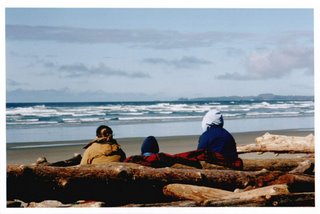 Tofino, British Columbia
The wind is blowing, and nothing will do till we’ve run to a pasture below the house where Queenie has scooted to bury her bone (and where, a winter hence, Queenie will be buried too.) There, plunging through the healthy waist-high grass, we unreel our kites, feel them twitching at the string like sky fish as they swim into the wind. Satisfied, sun-warmed, we sprawl in the grass and peel Satsumas and watch our kites cavort. Soon I forget the socks and hand-me-down sweater. I’m as happy as if we’d already won the fifty-thousand-dollar Grand Prize in that coffee-naming contest.
“My, how foolish I am!” my friend cries, suddenly alert, like a woman remembering too late she has biscuits in the oven. “You know what I’ve always thought?” she asks in a tone of discovery, and not smiling at me but a point beyond. “I’ve always thought a body would have to be sick and dying before they saw the Lord. And I imagined that when He came it would be like looking at the Baptist window: pretty as colored glass with the sun pouring through, such a shine you don’t know it’s getting dark. And it’s been a comfort: to think of that shine taking away all the spooky feeling. But I’ll wager it never happens. I’ll wager at the very end a body realizes the Lord has already shown Himself. That things as they are” – her hand circles in a gesture that gathers clouds and kites and grass and Queenie pawing earth over her bone – “just what they’ve always seen, was seeing Him. As for me, I could leave this world with today in my eyes.”
- A Christmas Memory, Truman Capote
 Tofino, British Columbia
Thursday, May 04, 2006
Read this book

"We left about midnight and walked down the hill in silence. The night was muggy, and all around me I felt the same pressure, a sense of time rushing by while it seemed to be standing still. Whenever I thought of Puerto Rico, I was reminded of those old magnetic clocks that hung on the walls of my classrooms in high school. Every now and then a hand would not move for several minutes - and if I watched it long enough, wondering if it had finally broken down, the sudden click of the hand jumping three or four notches would startle me when it came."
Truman Capote
Those final weeks, spanning end of summer and beginning of another autumn, are blurred in memory, perhaps because our understanding of each other had reached that sweet depth where two people communicate more often in silence than in words: an affectionate quietness replaces the tensions, the unrelaxed chatter and chasing about that produce a friendship’s more showy, more, in the surface sense, dramatic moments. Frequently when he was out of town… we spent entire evenings together during which we exchanged less than a hundred words; once, we walked all the way to Chinatown, ate a chow-mein supper, bought some paper lanterns and stole a box of joss sticks, then moseyed across the Brooklyn Bridge, and on the bridge, as we watched the seaward-moving ships pass between the cliffs of burning skyline, she said: “Years from now, years and years, one of those ships will bring me back, me and my nine Brazilian brats. Because yes, they MUST see this, these lights, the river – I love New York, even though it isn’t mine, the way something has to be, a tree or a street or a house, something, anyway, that belongs to me because I belong to it.”
- Breakfast at Tiffany’s
- Breakfast at Tiffany’s
Subscribe to:
Posts (Atom)


