Friday, April 13, 2007

Here we are, trapped in the amber of the moment. There is no why


"To whom it may concern: It is springtime. It is late afternoon."

I just found out that Kurt Vonnegut died. I've been out of the loop for two days, fully oblivious to this ENORMOUS fact, which seems entirely insignificant to the people to whom I've mentioned the news, hoping for a gasp to match the one I let out while skimming over the Globe's obituary section on the ferry, but getting nothing more than, "Who's that?" Maybe it's not the earth-shattering event I am making it out to be. But why does it feel like it's earth shattering to me?

I seriously thought he was going to live forever, as I did about Mother Teresa and my wily great grandma. And then these people die, at a zillion years old, and it makes sense, but it doesn't, because you're used to them being there, you're accustomed to and even comforted by their presence in the world - even if you don't know them. Because you've been influenced or affected by them, and want to (and expect to) continue to be influenced and affected by them.

The death of one old man isn't a tragedy in the grand scheme of things. But at the same time it is a tragedy to the esoteric community that makes up his cult following, to generations of book nerds who grew up on his writing, like two generations of the Thompson clan who grew up on my grandpa's famous spaghetti and meat balls. And I realize it's an obscure connection to make, but they're both familiar, and and that familiarity is comforting, and now there will be no more new Vonnegut stories, just as there are no more Grandpa T's spaghetti and meat ball dinners. He will never again write anything else. Ever. The world will have no more new Vonnegut. He's a thing of the past, now, like all those other famous dead writers. He's a dead writer! It's crazy. It's ... crazy.

All said and done, it was a weird day. I woke up this morning practically falling off the ledge of the bed. You could have fit a small family between Erin and me again. When I rolled over and made this observation Erin exclaimed, "No TOUCHING!!" like the prison guards to in Arrested Development, and I erupted. I can't think of any greater way to start the day than being laughed awake.

The maid cleaning the room beside ours wished me good morning as I was leaving, and called me ma'am. She was probably in her late 40s, and the elevator couldn't have come soon enough. There's something really embarassing about a woman, who could be your mother, whom you've never met and who is about to go wash your towels and make your bed and empty the garbage you threw in the waste basket, call you ma'am. I felt like I did at St. Anne's spa with my mom, while people massaged my scalp and rubbed essential oils into my feet. I didn't want to be associated with the pampered women traipsing about in their bathrobes (like hedonistic caesars), their faces shiny and glowing from $200 facials. Anyway, I felt bad. Maybe I don't want to be a kept woman, afterall.

So my guilt and I went for a long swim, and then had breakfast in a cafe, where I read all about new discoveries in the dinosaur world - seriously, dinosaurs are so rad!! Then went off to find the Victoria Art Gallery, tucked away in a little corner of town near Craigdarroch Castle.

I spent an hour in the practically empty gallery, alone with an amazing collection of Rodin sculptures (and I fully admit that I checked out the naked ones. Anyone who says they don't is a liar). There's nothing like being alone in a gallery, where you can take your time and go back and forth between pieces again and again. And what's amazing about Rodins is that they seem to have been designed with the purpose of being seen from every angle, as if each view is the main view. It boggles me how he could create forms that are at one time so muscular and commanding and strong, yet at the same time fluid and graceful and sensual. The busts were so incredibly life-like that I fully expected them to blink. But they never did, and so I moved on.

To close (abruptly, I admit, but I have to rush off to UBC), a Vonnegut quote, one of many that I love, and will probably love even more, now...

I want to stand as close to the edge as I can without going over. Out on the edge you see all the kinds of things you can't see from the center

More Vonnegut

Thursday, April 12, 2007

Epilogue: Catching life by the throat

Erin woke up at 6:00 this morning to go to the pool, and came back an hour later wide-eyed and bushy-tailed, trying to engage in conversation, a futile endeavor given my starfish, commatose state (I actually attempted to stay up to see how the hockey game ended - although, admitedly, the only reason I know the Canucks won was because the uproarious commotion from the commentators when Sedin scored jarred me from my sleep).

At 11:30 I finally tore myself away from the comforts of the hotel room to venture out into the grey, windy, oh-so-chilly (yet pleasantly picturesque) streets.

I can't count how many pictures I inadvertently walked through. It was, in my defense, unavoidable. Countless people are going to return from their trip with me in the background of their pictures. (What a crazy thought) And they choose to pose in front of the most random things. Some I get: the Empress hotel - makes sense; the harbour - I get that; even giant stuffed grizzlies - I'll give it to them. If I were walking down the street in Japan and saw a giant stuffed Sumo wrestler, or piece of sushi, I'd pose with it, too. But others... I just want to go up to people with a pen as a microphone and say, "Why THIS backdrop?"

Everywhere I go in downtown Victoria seems to implore me to "re-connect" with my "Irish roots," to buy a wool sweater or anything tartan. A block later and it's English tea time in a tudor-style cafe sitting kitty-corner to a shop of First Nations bric-a-brac, its windows full of signs in Japanese. Down the road people are asking me if I've found Jesus and handing me salvation cards (which I politely decline) outside the gates to China town, and I feel on the verge of an identity crisis. Harmonica-playing mimes on unicycles deke out Japanese tourists plodding along like schools of fish, taking pictures of lethargic-looking horses strapped to carriages, and dred-lock-sporting peudo-homeless youth squat in doorways selling hacky sacs (I turn the symbol of my Starbucks mug away from them when I walk by - for some reason I care what they think). This, I suppose, is the appeal of Victoria, or Canada, for that matter: a kind of schizophrenic diversity we call multiculturalism.

I got blissfully lost in Beacon Hill Park - a.k.a. the world bird poo capital - and sat on a bench in memory of Georgina somebody-or-other, suspiciously eyeing crows who suspiciously eyed me back (as if I was competition for the garbage they were pecking at on the lawn).

And if you ever go wandering along Government Street - where Emily Carr's house is - along roads lined with colonial-era cottages-turned-B & Bs, with rose bushes in every yard and lazy cats in every sun-drenched bay window, listen to Jose Gonzales' Heartbeats. In fact, put it on repeat. You won't get sick of it - I promise.

Then sit at the park that looks over the water at the end of the road (I only discovered it because I was lured by an enticing little gravel path). To the left a windswept, craggly, cliffy vista that conjures up images of some Thomas Hardy novel, and to the right a Pacific Northwest landscape, with layers of low-lying mountains in varying gradients of slate blue. Pair this with a little Iron and Wine and you won't be sorry.

This place, with its fresh, breezy lightness and expanse of glimmering ocean, somehow balances out Larkin's heavy existentialism, which sits on my lap in the form of a dog-eared book, its pages flapping in the wind.

"I see life more as an affair of solitude diversified by company than an affair of company diversified by solitude," he writes. The sentences jumps off the page at me as I sit alone on a park bench watching people amble by. I've never been so glad to be in nobody's company than my own.

Yet ironically (paradoxically?) he says at another point, "What will survive us is love," which I read as the little voices in my little white earphones sing, "There are times that walk from you like some passing afternoon, summer warmed the open window of her honeymoon," just as the sun finally comes out for the first time today. And the combination of those three experiences at once: reading that Larkin line, hearing that Iron and Wine lyric, and the sun warming me, makes my heart skip a beat for a minute.

I look up and the birds above and the boats below go sailing past while the grass waves in the breeze, and the song plays on: "There are things that drift away like our endless numbered days, autumn blew the quilt right off the perfect bed she made... There are sailing ships that pass on our bodies in the grass, sprintime calls her children til she lets them go at last... a baby sleeps in all our bones so scared to be alone," while Larkin continues to write about solitude and the significance of small events, like a visit to an empty church, that "gives weight to the ordinary dreams and fears of our daily lives, lived out as they are in the shadow of eternity."

It's almost too much for me to process. Yes, yes, yes.


Hotels - observations and assessments

What I love about hotels:

- TVs in armoires
- endless supply of white towels
- bathrobes
- the glorious crispness of all fabrics
- you show up: the room is spotless. You leave your crap all over the place then go to get a Starbucks (I mean... Blenz). You come back: all your crap is cleaned up. It's like magic!! Or like clandestine, invisible gnomes infiltrate the room the moment you leave. I must lure and capture one and transport it home in my bag
- teeny toiletteries to bogart
- complimentary tea
- informative pamphlets in the hotel lobby

What I hate about hotels:

- the messed up channels -- Bravo is on channel 37?!!
- the temperature control gizmo having menopausal hot and cold flashes throughout the night
- when your key card refuses to instigate the green "unlock" light on the door handle, even though you KNOW you're at the right room and really need to pee
- never being quite sure if you managed to program the alarm properly
- ineffective dollar store hair dryers
- pastels and floral print
- the lure of the mini bar

Fetch me my smelling salts!

It's 9:36 a.m. and I have no idea what to do with myself. I've been a kept woman, living in the lap of luxury for exactly 15.5 hours now, and, you know, it can be a bit boring! Not that I'm complaining! Lest God should sweep down and remove me from this luxurious 5-star hotel room, swipe the delicious (albeit instant and flavoured with whitening powder) coffee from the desk beside me, replace this view of Victoria harbour with, well, anything else and... well... that's about all He can do to me right now.

Yes, this is quite an upgrade from my Vancouver abode - with the alley bums and the upstairs neighbours and their midnight sumo fights, and the perpetual smell of pot and bus exhaust wafting in through the various cracks in windows and floorboards, which keep the place freezing cold in the winter and slightly bug-infested in the summer. QUITE an upgrade, indeed.

I've just finished Monday's workology story (THIS, people, is why I decided to become a writer. Am I poor? Heck yes. But am I working from a laptop many miles away from home gazing at the ocean and Washington mountains out the window? HECK YES! Did I traverse great distances via ferry to get here, watching for whales and seals? You KNOW it!), what was I saying? Oh yes. I just finished Monday's workology story after awaking from a long and glorious post-Vancouver-nearly-5-overtimes-sudden-death-win-over-Dallas sleep in a MAGNIFICENT king-sized bed, which allowed my lover for the next two days, Erin Shannon, and me to sprawl at our leisure and never come within three metres of (soft) touching each other (which is a shame, because we both anticipated copious amounts of spooning ... maybe tonight).

Hang on, I've got to shut the patio door or else the biggest seagull I've ever seen in my life, which is perched on the railing, might venture inside to steal some of Erin's Glosette peanuts which I've been eating for breakfast (and which she informed me in no uncertain terms last night were off-limits).

Door closed. I didn't even have to get UP to close it, but merely reached over and with a single swipe crisis was averted! Now what to do? Stalk people on Facebook? I can do that at home. Lounge about in a terry cloth bath robe on the gigantic bed, reading my complimentary Globe and Mail? It's a distinct possibility, although the cover story is Belinda Stronauch, so... gak, snooore. Or maybe go down to the pool and do some laps? Order room service? Jump on the bed? Try on all of Erin's clothes? Press every button in the elevator? Ride it up and down marvelling at the view? (the elevator has a view!) Make more coffee? (I don't even like coffee!) Watch crappy day-time TV? Read this Bible I found in a drawer? Make a fort? Drop things off the balcony? (eep... No. Seagull-patrolled) Eat more Glosettes? Have a bath? Finally put on some pants? (haha! just kidding. Ya RIGHT I'm putting on pants!). See how Marty McFly gets out of his current predicament in Back to the Future 2? Invite the seagull in for tea? The possibilities are endless!

I do love Victoria. It's like a... a.... it's like a more spacious and tackier York (English York, not Ontario York). And it seems to me that, unlike Vancouver's downtown core, which is set up to accomodate commerce, Victoria's downtown core exists purely for the tourists. And I love coming here because I am both a tourist and not a tourist. It's like Vancouver, but different enough that I'm not bored of it. It's different enough that every shop and cafe and view is worthy of checking out and appreciating, but not so different that I'm mesmerized and blocking sidewalk traffic at the sight of boats, or stalking squirrels on the lawn outside the Parliament buildings like a National Geographic photographer on safari.

I might, when the shops open in ten minutes, venture into all the horrible little tourist trap shops, which I love to peruse (yet never spend a dime in) because it's funny to try to see Victoria/B.C./Canada from the perspective of a tourist (is this how they interpret this place? A world of tiny Maple Syrup jars; Native feathers, windcatchers and mocassins; stylized grizzly bear, eagle and whale figurines; cheap stationery adorned with ubiquitous Canadian flags; fridge magnets bearing images of pristine glacier lakes and endless vistas of pine trees?) find some little cafe with an outdoor patio and have breakfast with my date: Sylvia Plath and Philip Larkin, or maybe march along a cozy cherry blossom-lined suburban boulevard with my Ipod (that is, if it decides to cooperate today).

Or maybe I'll go back to bed.

Tuesday, April 10, 2007

Putting a spring in your step


You know it’s finally spring when you rip the weather stripping from around your draughty window and throw it wide open – to hell with worrying about masked criminals and crazed hobos crawling through it cuz you live on the ground floor. I tell you there’s nothing like sleeping in a bedroom with crisp fresh (fresh-ish) air circling your bed and filling your lungs, bringing with it smells of newly-cut grass and the sounds of the alley folk clanking their carts outside.

*sigh*

Nothing changes my mood and general outlook on life like a warm, sunny spring day after months of monotonous grey drizzle, being perpetually wet, drying your jeans over an electric heater and putting on shoes still damp four days after walking home from the grocery store through two feet-deep puddles (they’re unavoidable. I’d have to walk with the traffic to deke out those stupid puddles). The winter, with its heavy weather and heavier comfort food, 4 p.m. nightfalls that don’t inspire you to leave your apartment to get any sort of exercise, makes me physically, mentally and emotionally lethargic, my days spent grumpily going about my business, and my evenings hidden under piles of heavy blankets in my freezing cold apartment, sarcastically mocking TV and trudging about with utter disdain for life.

All it takes is a lift in the clouds for all that to change, for my apartment to go from a prison-like cave to a delightful abode, the pitiful state of my bank account from a horrible obsession to a laughable situation. From putting my head down and scuttling from one place to the next, cursing the cold, needle-like rain, to walking immense distances and delighting in every sight, sound and smell.

I drove home from UBC the other day along Marine Drive to dig the view, my windows rolled down, my Ben Harper/Shins mix blasting, and couldn’t believe the incredible beauty of Spanish Banks, the choppy water dotted with white sail boats and brave windsurfers, the snow-capped mountains against a crisp, blue backdrop of sky, the shimmering downtown skyline, the infinite kites and bike riders and joggers and loping dogs. It's as if I'd never seen that sight before. Clouds have never been whiter, the water never bluer, the trees never greener and more pine-fresh and fragrant. I drove behind a train of cars going 30 km/hr, which typically would have put me in an apoplectic road rage, but which suddenly made me… happy, because what’s the rush when you’re driving along Marine Drive on a sunny Friday afternoon with Ben Harper and the birds singing in unison for no one else but you?

And I started thinking: there’s REALLY nothing as glorious and LIFE CHANGING as having the rain clouds lift after six hideous months, to reveal this beautiful scenery previously hidden behind a curtain of grey and drizzle. To make me remember why I live where I live (my grandmother constantly asking me: “Why do you live in Vancouver?” and me never being able to articulate WHY. This is why!). And in a funny sort of way the rain serves a good purpose, in that it makes us appreciate the blooming tulips and bright blue sky even more when the nearly forgotten sun finally comes back from its winter vacation.

It hit home even more today, walking home from a downtown Workology interview over the Burrard Street bridge and through Kits. As I hit the woods on the south side of the bridge I was suddenly overwhelmed by the scent of this grass, or maybe it’s a tree or a plant. Every spring I smell it and every spring it whisks me immediately back to childhood Fort St. John summers. Nothing transports me back to that specific time so suddenly and so overwhelmingly like that smell (and the smell of deet) – to day trips to the lake where the bottom was so rocky I had to swim with my tennis shoes on, where I had perpetually skinned knees and sunburned cheeks, where I lived off hot dogs (in the days before I liked ketchup – so they were plain in a bun) and jiggly heart-shaped jello pieces and Allen’s apple juice in tetra paks.

A few blocks down the street and I was walking under whirling cherry blossom pedals which transported me 20 years down the road, to hanami parties in Japan, playing badminton under the cherry trees in full bloom (like balls of cotton candy) and drinking Asahi tall boys on blue tarps, getting home as the sun set for a frozen pizza dinner and hour-long nap, only to wake up again at 10 p.m. and head out to an izakaya or random house party or all-you-can-drink roof top gong show, riding my bike home at 3 a.m., swerving around drunken salary men while marveling at the enormousness of the full moon and thinking (as I only seemed to think when I was drunk or stoned or perhaps on a road trip to Kyoto or Tokyo): Holy CRAP – I live in JAPAN. And waking up the next morning with nothing else to do but watch Zoolander for the 200th time, laying around in pyjamas on a tatami floor with the patio doors swung open wide, shooing away pigeons and drinking tea.

In a single Vancouver walk home it’s possible to re-live an entire lifetime, lived all over the province, country and world, through all these triggers that link each event and life stage like a paper chain, so that 27 years are summed up in 60 minutes, 40 blocks, ten songs on your Ipod, the entirety of Fleetwood Mac’s Rumours. From the smells of fresh cut grass and memories of childhood soccer games, juice from orange slices(which I avoided) dripping down tanned arms and running away from June bugs, to smells of barbeques and memories of Canada Day bike rides through Thornhill’s meandering ravines. All these thoughts coming at once, overlapping and switching from one to the next in unannounced bursts, as if springtime shakes the cobwebs and woolen blankets and rain clouds from my winter-heavy, hibernating mind and brings it – and me – back to life.

Monday, February 26, 2007

The newest member of the family

She still needs a name :)

Wednesday, February 07, 2007

If you're not part of the solution, you ARE the problem

(If foreign aid is such a failure, why do we even bother)

It's hard not to feel guilty for our freedoms and comforts, living in a country of relative wealth, where most people have not only what they want, but what they need. What did we do to deserve this life, and how could it all be anything but mere luck of the draw?

And what can we possibly do with this guilt? Lament over the lives of those who live (survive) in a perpetual state of want, with disease, hunger, war and death? We're so removed from that world that it doesn't even seem as if it IS our world, or our problem. In one sense, it's NOT our problem. We have no responsibility over these people or their plights. But in the other sense, all human suffering is our own suffering, and therefore our responsibility.

John Donne said it best when he wrote, "Any man's death diminishes me, because I am involved in mankind." That sentiment doesn't ring any less true 400 years later.

But what's one person against so much destructive force? And if someone were to have the determination and compassion to want to help, what, they might ask, would be the point? Will their contribution do ANYTHING? Certainly the media spends far more time preaching how foreign aid is failing, than helping.

So why do anything.

And that's just the problem. In a way the incentive is gone, and the endless cynics (not the same as realists) who think they are helping by "informing" us about the "true" state of aid, are really just making it worse, by filling us with horror stories of corruption, waste and misuse of aid, monetary contributions being gobbled up in administration; about how, no matter how much you give, it's never enough, and poverty (with all its side effects: disease, crime), like a plague, continues unabated despite our measly efforts at combatting it.

Who wants to open their cheque books or fight for seemingly lost causes?

When's the last time we heard any of the positive stories, where non-profits were doing even the tiniest measure of good? Where are the stories of success? Where is the insentive to not only help, but to continue to look for solutions? If the UN can't stop genocide, and the Red Cross can't combat AIDS, and UNICEF can't give children an education, what is the point?

MacLeans' main World article this week is the utlimate case in point, titled So Much For Foreign Aid. Its deck: Africa's new curse is a crippling brain drain. Its chief cause: us.

Fabulous. More reasons why we, the wealthy west, despite all efforts of philanthropic, well-meaning and bleeding-hearted NGOs, are still fucking up. Not even fucking up. Making it WORSE.

The main point of the article was that "we" are stealing what few educated professionals are left in Africa and enticing them back to Europe and North America. Not that these people are abandoning their countries (I can't say I blame them. They have every right to seek out and live a life of safety, freedom, health and happiness, and if their own countries can't provide that for them, why should they suffer?), but that we are, for all intents and purposes, stealing them.

It then goes on - as a convoluted sidetrack - to suggest our foreign aid is not only doing nothing to help, but making it worse, by putting money in the hands of greedy, corrupt governments, and perpetuating wars, poverty and disease.

"The money is frittered away by inefficient bureaucrats or finds its way into the bank accounts of kleptomaniac politicans, while the poor remain as desperate as ever."

The author cites two novels to back up his claims, entitled White Man's Burden: Why the West's Efforts to Aid the Rest Have Done So Much Ill and So Little Good, and The Trouble With Africa: Why Foreign Aid Isn't Working.

"The issues that most perpetuate under-development, according to critics to traditional aid, are often actually made worse by aid," he says, going on to call Africa one of the biggest "sinkholes" of foreign aid.

"Aid money not only supports huge bureaucracies but promotes corruption and complacency. Africans are taught to be beggars... it weakens local economies and defeats 'the spirit of entrepreneurship.'"

Makes me want to emotionally wash my hands clean of Africa altogether. Praise to the author, for being one of millions of people tirelessly pointing out the infinite failures of aid, without proposing any solutions.

He presents these huge problems that are seemingly unfixable:

"The British government's Commission for Africa last year suggested that the number of skilled migrants leaving the continent is pretty close to the number of foreign technical experts being sent in as part of international NGO projects or foreign aid packages... A larger homegrown skills base would be beneficial for all sorts of reasons, including lowering dependency on foreign expertise which, as history tells us, does not come value-free."

So what's the solution? Africa can't fix itself on its own. Someone has to facilitate change. Someone has to educate these people, create skilled workers, create trade. But what about the day-to-day issues? Small things like providing wells for safe drinking water, medicine, health-care clinics, school supplies.

I agree that African countries need to fund their own development, and constant infusions of money is a band-aid solution to a complex set of problems many of us really don't understand. But changing the way the continent functions, raising GDP and promoting economic sustainability and the means for self-government, creating health care and education sytems, will not happen overnight, and certainly cannot happen unassisted. And people need the most basic necessities of life - water, medicine, school books in the meantime. Is cutting this kind of basic aid out altogether any kind of solution?

The caption under the main photograph reads, "MONEY FOR NOTHING. Rich countries have spent some US$2.3 trillion in aid over the past 60 years. What has it accomplished?"

That's a good question. And instead of writing a four-page article about how it has done NOTHING, why not write a two-page article on how it's gone to waste, and WHY, and another two pages on ways this money HAS made a difference, and WHY. Because you can't convince me that over SIXTY YEARS every penny has been spent for nought.

"The international community might also take note that efforts to keep countries stable and civil are more critical to the future of a continent like Africa than simply pouring in money. Burundi's real poverty is not simply material but that it persists in being the kind of place that drives out [skilled professionals]."

The author might have a point, but he offers no solutions of any kind, and no indication that anyone else has solutions in mind or in the works. It's irresponsible, one-sided journalism, that offers no hope, and if anything will discourage people from giving any more than they already do.

What HAS foreign aid accomplished? Where are our success stories, and why are they NOT being told?!

Consider...

"Afro-pessimism or afro-optimism? Although the media conveys an image of a poverty-stricken continent overwhelmed by the torments of war, famine and disease, there is a multitude of positive examples of an Africa that is succeeding and concrete evidence of rapidly developing economies." (from the Peace Journalism magazine, January 2007).

Being critical of systems that fail the people they aim to help is, in a way, one step to prompting change. But one step that isn't followed by another goes nowhere. The next step should and must be towards solutions. Because without the incentive to continue looking for more and better ways to help, who will be left with the energy, drive, passion or desire to do ANYTHING?

To truly understand the incredibly complex problem that plagues so many African countries, we need to see how we're not just compounding the situation, but improving it. Without both sides of the picture, we will be uninformed, and our perspective and understanding one-sided and skewed.

And so, for those simple success stories that will make you want to do MORE (not less) to help:

* Red Cross - Family in Sierra Leone expresses gratitude to Canada for bed-net - www.redcross.ca

* Engineers Without Borders - Poverty is not about weakness. For the 800 million people who go hungry each day and the one billion who lack access to clean water, poverty is an absence of opportunity - www.ewb.ca/en/whoweare/index.html

* Water for Life - www.pumpaid.org/

* Council on Foreign Relations - www.cfr.org/index.html

* The Aga Khan Foundation Canada - www.akfc.ca/

("Be the change you want to see in the world")

Wednesday, January 31, 2007

Fellow wordies, enjoy!

Once again, The Washington Post has published the winning submissions to its yearly neologism contest, in which readers are asked to supply alternate meanings for common words.

The winners are:

1. Coffee (n.), the person upon whom one coughs.
2. Flabbergasted (adj.), appalled over how much weight you have gained.
3. Abdicate (v.), to give up all hope of ever having a flat stomach.
4. Esplanade (v.), to attempt an explanation while drunk.
5. Willy-nilly (adj.), impotent.
6. Negligent (adj.), describes a condition in which you absentmindedly answer the door in your nightgown.
7. Lymph (v.), to walk with a lisp.
8. Gargoyle (n.), olive-flavored mouthwash.
9. Flatulence (n.) emergency vehicle that picks you up after you are run over by a steamroller.
10. Balderdash (n.), a rapidly receding hairline.
11. Testicle (n.), a humorous question on an exam.
12. Rectitude (n.), the formal, dignified bearing adopted by proctologists.
13. Pokemon (n), a Rastafarian proctologist.
14. Oyster (n.), a person who sprinkles his conversation with Yiddishisms.
15. Frisbeetarianism (n.), (back by popular demand): The belief that, when you die, your Soul flies up onto the roof and gets stuck there.
16. Circumvent (n.), an opening in the front of boxer shorts worn by Jewish men.

The Washington Post's Style Invitational also asked readers to take any word from the dictionary, alter it by adding, subtracting, or changing one letter, and supply a new definition.

Here are this year's winners:

1. Bozone (n.): The substance surrounding stupid people that stops bright ideas from penetrating. The bozone layer, unfortunately, shows little sign of breaking down in the near future.
2. Foreploy (v): Any misrepresentation about yourself for the purpose of getting laid.
3. Cashtration (n.): The act of buying a house, which renders the subject financially impotent for an indefinite period.
4. Giraffiti (n): Vandalism spray-painted very,very high.
5. Sarchasm (n): The gulf between the author of sarcastic wit and the person who doesn't get it.
6. Inoculatte (v): To take coffee intravenously when you are running late.
7. Hipatitis (n): Terminal coolness.
8. Osteopornosis (n): A degenerate disease. (This one got extra credit.)
9. Karmageddon (n): its like, when everybody is sending off all these really bad vibes, right? And then, like, the Earth explodes and it's like, a serious bummer.
10 Decafalon (n.): The grueling event of getting through the day consuming only things that are good for you.
11. Glibido (v): All talk and no action.
12. Dopeler effect (n): The tendency of stupid ideas to seem smarter when they come at you rapidly.
13. Arachnoleptic fit (n.): The frantic dance performed just after you've accidentally walked through a spider web.
14. Beelzebug (n.): Satan in the form of a mosquito that gets into your bedroom at three in the morning and cannot be cast out.
15. Caterpallor (n.): The color you turn after finding half a grub in the fruit you're eating.

And the pick of the literature:

16. Ignoranus (n): A person who's both stupid and an asshole.

Sunday, August 06, 2006

Read this book

Miss Wisteria stood so near he could smell the rancid wetness of her shriveled silk; her curls had uncoiled, the little crown had slipped awry, her yellow sash was fading its color on the floor. "Little boy," she said, swerving her flashlight over the bent, broken walls where her midget image mingled with the shadows of things in flight. "Little boy," she said, the resignation of her voice intensifying its pathos. But he dared not show himself, for what she wanted he could not give: his love was in the earth, shattered and still, dried flowers where eyes should be, and moss up on the lips, his love was faraway feeding on the rain, lilies frothing from its ruin. Withdrawing, she went up the stairs, and Joel, who listened to her footfalls overhead as she in her need of him searched the jungle of rooms, felt for himself ferocious contempt: what was his terror compared with Miss Wisteria's? He owned a room, he had a bed, any minute now he would run from here, go to them. But for Miss Wisteria, weeping because little boys must grow tall, there would always be this journey through dying rooms until some lonely day she found her hidden one, the smaller with the knife.

Sunday, July 09, 2006

Nature at war 2

I got dive-bombed by a squirrel on my way home from work today.

Monday, June 26, 2006

Nature at war

I saw a squirrel getting dive-bombed by a crow on my way home from work today.

Tuesday, May 30, 2006

Samsquanch

Wolfmother - Joker and the Thief.


Powered by Castpost


How do you start off the story of a three-day cross border weekend adventure (the kind typically referred to, in my group of friends, as a gong show) so it doesn’t sound like every other trip of its kind? It’s hard, when they all start the same: Friday after work, like herding cats, we all manage to get ourselves in one place, pile our possessions in the back of someone’s poor car, and head south (or sometimes north) out of the city’s slow-moving rush hour traffic, our windows rolled down, arms thrown out in accompaniment to shouts of “Wooooooh!!!!”

And they all end the same too: rolling back home on a Sunday night, grubby and sun or wind-burned with piles of laundry.

But the stuff in the middle, the meat and cheese of the city-getaway sandwich, is never the same.

I look forward to these getaways, whether to Whistler or Seattle or Oregon or the Rockies, like a prisoner of war looks forward to his daily potato. This particular steaming hot potato involved an epic Friday night drive across the border and into Washington’s badlands, destination: The Gorge for The Sasquatch Music Festival.


The drive up: eight people piled into Allyson’s newly-acquired van, known in the UBC days as the Funkmobile, now dubbed Bubba. We consumed mass-amounts of junk food and Miller High Life (left over from the previous weekend's surfing trip to Oregon, to which I was excluded due to work), and by the time we were over the border (each border crossing inevitably involves the re-telling of every terrifying and hilarious customs experience each of us has ever experienced), the mass beer consumption necessitated a million pee breaks.


Each stop was an excuse to interact with the other two cars in the convoy and bust rowdily into an unsuspecting Shell gas station or hotel lobby and pile three at a time into single-occupancy toilets. The drunker we got (minus, of course, the three drivers), the funnier each pee stop got. The highlight, other than Keith and Cheryl’s discovery of “snausages” (pretzels rolled around cheese, indistinguishable from dog snacks) and Keith’s and my discovery of a beer we dubbed “Angry Penguin Beer” (made in Canada but exported directly out of the country to be sold at gas stations for $2.50 US for a six pack, or $4.89 US for a twelve), was Gunner’s breathtaking wipe-out in a gas station just outside of who-knows-where Washington.

It went something like this: Erin and Gunner’s kidneys were officially exploding. Mine weren’t far behind. We pulled into a lonely gas station and the sliding door was open before Ally had fully come to a stop. Erin did a rolling jump out (it would have made Steven Segal’s stunt double proud) and made a run for it. Gunner came next, hot on her heels, and I followed. We got into the convenience store and rounded corner number one (a sharp right behind the Bugles and Sun Chips). Erin made it around and was nearing corner number two (a sharp left down the bathroom hallway) when Gunner, still rounding corner number one and wearing flip-flops with a scarce amount of tread, went down like a speed skater on his last lap with an Olympic gold in his sights. He went down hard, flat on his front and did a little skid into the slurpy machine (or was it a rack of road maps?).

Erin turned around briefly at the commotion and did a hysterical skipping prance while unbuckling her belt, and I went down into the Excalibur position (on one knee), knowing that peeing my pants now would be a waste, given how close I was to the washroom. Gunner moaned an “Ow,” pulled himself up and kept going to the men’s washroom. I rounded the corner myself, buckled over giggling, and could hear Erin, now behind the closed women’s washroom door, in paroxysms of laughter on the toilet. And she remained that way, red faced and laughing, trying to tell the story of Gunner’s fall through giggles when we finally made it out to our friends standing at the gas pump.

(Rossy Interlude: "All I remember from the Great Gunner wipeout is coming around the corner and seeing mass hysteria. As I was trying to get the info out of an out of control Kristen who was pulling me towards the bathroom door to hear the mad cackling from behind it, a stonefaced and silent Keith had grabbed my other hand and was pulling me towards the wall or something. Drunken and confused, my mind couldn't gather what was going on as my head was being pressed against the women's bathroom door, and my left hand was being used as a middleman fondling mechanism for Keith, whom I hadn't really gotten to know yet. It turns out Keith had just wanted me to touch the brail. That is what I remember from the Great Gunner wipeout.")

We continued the ultra hilarious A to Z car game, moving on from “discharge” to the topic of “body cavity searches at the border crossing.” “Ribbed” was the highlight, other than maybe McFarlane’s, “What was that, R? What comes after R? U! Umm… UGANDA!!”

There was also the famous stop at Haggen for food and booze. We were nearly in the parking lot when someone with a quick eye noticed that the Krispy Kreme on the other side of the parking lot had its doughnut light on, which meant that a fresh batch had just been pulled from the oven and samples were being given out for free. (Last time we tried to hit up Krispy Kreme it was closed, although that didn’t stop Diga from trying to place an order at the drive-thru anyway). Ally did a doughnut, excuse the pun, in the parking lot, and b-lined it to Krispy Kreme, pulling through the drive-thru and asking the little squeaking box,

“Hey, so, doughnuts! Um, word on the street is that you’re giving them away for free or something?”

To which the little box responded, “That’s right. If you park and come in you get a free doughnut.”

The car immediately erupted into an earth-shattering celebratory roar, sixteen arms shooting up in the air, and as we peeled out we distinctly heard laughing from the squawk box.

We parked the car on the other side of the shop and exploded out of every door like a breaking geyser, empty beer cans spilling all over the parking lot in a cacophony of clanking metal, and we ran in for our free doughnuts. We left twelve seconds later, two of us wearing paper Krispy Kreme hats. It was my first Krispy Kreme, and will most likely be my last. After one bite I had handed it over to Gunner who had already inhaled his own.


Haggen was an in-out operation. We played Price is Right with the bill, making sure to include the cashier, Christine, in the game. Deanna won this time with “$102, Bob.”

We finally arrived at the campground sometime after 1:00 a.m. There was no rhyme or reason to the parking/camping situation, and the cold, tired people in navy blue Sasquatch windbreakers and flashlights who took our camping ticket had no idea what was going on, so we drove aimlessly through the darkness, weaving through small hoards of meandering campers and divisions of the seemingly endless sea of tents, looking for a congregation of port-o-potties with a big number 22 painted on a piece of plywood. There we were to find Anna, who had reserved a spot for us near her tent. It was spookily easy how quickly we found her, or she found us, and we pulled in and began setting up our tents, shivering in the black Washington night.

Once the tents were up everyone plopped into their sleeping bags, Ally, Dom, Cheryl, Keith and I, not ready to call it a night yet, sat up in Bubba, who was now being called “The Ranch on Wheels,” or “The Mobile Ranch” (in honour of Dom and Ally’s house, which is called The Ranch), and we drank in the dark and played more A to Z until it was finally time for us to tent-it-up ourselves.

I fell asleep to the sound of Dominic discussing how fun it is to say the word “snausage.”

It down-poured all night long. The heavens opened up and flushed their toilets on the poor inhabitants of tentland, hunkered down in a giant cow field and trying to get some sleep in preparation for twelve straight hours of concerting scheduled for the next day. Every single person in tentland who had drank too much and had to pee in the middle of the night (I estimate that to be about seventy percent of the community) lay there in agony in their sleeping bags, cursing the freezing plops of rain on the roofs of their tents and the distance they would have to travel to the nearest port-o-pottie for a terrifying pitch-black wazz. I lay there somewhere between an hour and a half to two hours until I saw the crack of dawn squeeze through the grey roof of my tent, and sucked it up, now sure I had done some permanent internal damage, put on some flip flops and grabbed an umbrella, and trudged through the cold, miserable, sopping grass to the dirtiest port-o-pottie I have ever had the pleasure of utilizing.

When I got back I saw the little heads of Rossy and Deanna poking out of their tent.

“Good morning sunshines,” I happily saluted them, for, even though I was cold and wet and hadn’t slept a wink, I no longer had to pee, and was looking forward to my warm sleeping bag.

Deanna responded to my chipper greeting with, “Are you wearing a nightie?”

“Yes,” I said, looking down at the skirt I had put on so as to not get the cuffs of my only pair of sweat pants wet, “I always go camping in a nightie.”

Which is when Erin came scurrying over from the van, informing me that the tent she, Deanna and Rossy had been sleeping in had flooded, and they were moving camp into smelly Bubba. I wished them luck and zipped myself back into my cozy tent and went back to sleep, lulled by the melodic snores of Keith.

(Rossy Interlude #2 : "As Deanna, Erin and myself awoke that morning to wet pillows and sleeping bags, we couldn't help but laugh at the stupidness of the situation. Our poor little tent had simply given up the will to protect us from the elements and was now in a pre-death collapse as rain dripped on us from the sides and the roof, and water moved in like a silent menacing snake. A we giggled and dissed our tent, frustration slightly grew as someone exclaimed, "Who the hell uses napkins as flies on tents? " Damp, cold, and hungover, Erin decided to take first action and brave the rains outside to get the keys from a sleeping Ally so that she could move into the comforts of the van. However in doing so, she awoke the Water Beast, which allowed all the water that was being held at bay by the flimsy sides of our little-tent-that-couldn't to rush forth, causing squeals, laughter and exclamations of "stop moving Erin, you are waking the Water Beast." Sadly, Deanna and I had had to abandon our little tent as well, leaving it standing there in the rain like the that sad little lamp form that IKEA commercial a few years back. But it will be a great summer tent.")

We woke up around 9:00 and unzipped our tents when the rain subsided to a less threatening pitter pat on our tent walls. As we shook the sleep from our eyes and unlocked Bubba to get at the juice, water and Erin’s cinnamon buns, we got our first glimpse of the landscape we had driven through in the dark the night before.

We were a million tents deep into a sprawling city of dripping nylon and wet cars, in a huge expanse of field that stretched for miles in either direction. To our left and behind us the land was flat and grassy, but to our right, and straight ahead, lay rolling green, brown and yellow hills topped with layers of heavy low-lying charcoal clouds interspersed with bright white fluffy clouds. Behind the dense, looming sky that threatened thunder and lightning and crisp May rain were splatterings of bright blue sky. The sky looked both menacing and inviting, and cast huge dappled shadows on the hills.

It was beautiful. The whole sight was beautiful, even with the dilapidated, rain-drenched tents, clusters of port-o-potties, and the bits of sun sparkling off the chrome of several thousand bumpers and license plates boasting state and provincial mottos from regions as close as Alberta and Oregon, and as far away as Michigan and Alabama. It was both pristine and filthy, orderly and ramshackle, dry and wet, sunny and overcast, quiet and noisy, energetic and groggy, happy and hung over – this converted cow field where tractors were still making their rounds through rows of tents and piles of discarded beer cans, and spiders picked their way through long blades of grass into the sunshine (and eventually into my tent).


The people who were sleeping beside us had been given, by mistake, a kitchen tent instead of a regular tent, and had spent a miserable night getting rained on through the screen walls. They got up early and drove to Seattle to buy a real tent for the next night. We took advantage of the empty tent and its plethora of seating options (chairs, air mattress, coolers) to create a socializing area just as the rain returned. We gleefully accepted compliments by passers-by who admired the arrangement, announcing with pride that we commandeered the tent and all its possessions, including the ripped poncho I was sporting, while the owners were who knows where.

(Rossy Interlude #3: "Not only did we commandeer their tent and poncho, but also their chairs, cooler, air mattress, and if time had allowed us to do so, we probably would have polished off their milk and premade burgers while curled up in their blankets. Hell we probably would've packed up the tent of they had never returned by the time we were ready to leave.")

We also made friends with a Colombian whose name I’m still not sure of, since everyone immediately gave him a nickname. Out of the following names he was called by my friends: Javier, Juarez, Juan, Joaquin, and Joaquin Phoenix, one of them is likely to by correct. He had rescued a stranger the night before when the poor guy, hammered and discombobulated, had lost his friends and couldn’t find his way back to his tent, and was sleeping in a blanket in the rain. “Juan” invited him into his tent and saved him from certain death from exposure.

After a breakfast of left-over Haggen sandwiches and salads and a few glasses of juice, we cracked open the beer, and from 9:30 onwards drank in and out of our commandeered tent, in the sunshine and rain, until we were all good and tanked and ultra elated with life.

On one of my many, many, MANY trips back from the terrifying port-o-pottie #22 base, I took a wipe out on a loose rope on Aiden’s tent. Juan came running up to me with concern. I pulled myself up and examined the damage: a muddy knee.

“Never mind the TENT!!” Juan exclaimed as he lugged me to my feet, “Are YOU okay?!!!!”
I laughed, slightly embarrassed. He was relieved, and then said to me, “Here, come join my new group of friends,” ushering me forwards and pointing to everyone drinking in lawn chairs. Juan ran off, happy to have given me some new friends.

The sun officially came out around noon, and we left tent land for the twenty minute walk to the Gorge at around 3:00. Erin took a fabulous slow-mo bail into a ditch while mimicking the Excalibur pose I went into when Gunner wiped out. The fabulousness just wouldn’t end. We also allocated buddies to make sure no one person got permanently lost from the group. I was buddied with Gunner and Erin. The buddy system, not surprisingly, quickly broke down. We have yet to find a system that works. The closest we’ve ever come was our fluorescent t-shirt Arts County Fair. But even that was full of flaws.

(Rossy Interlude #4: "Aiden and I were buddies and we had no break down in our buddy system, except for when it came for Aiden and I to fend off the hail under our own blanket. I needed the extra body to create more cover and Aiden wanted to take the hail like a man. "Aiden get under the blanket and work with me!!!" He didn't and I fled.")

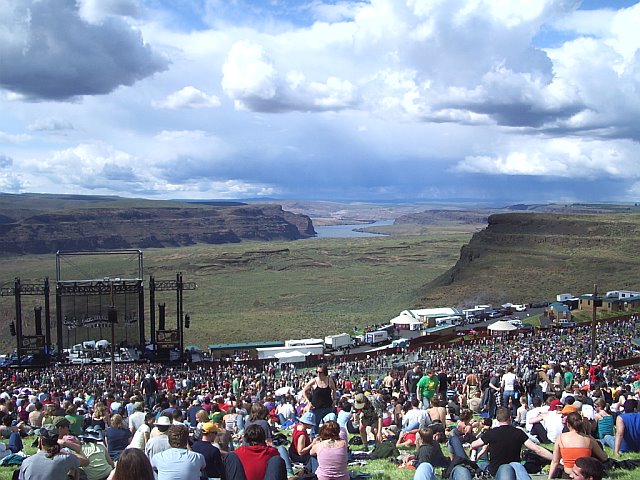
Iron and Wine were on stage when we arrived, and we got ourselves a beer and a spot on the grass at the top of the hill and marveled at the view.

Halfway between Seattle and Spokane, the Gorge is in George, Washington, and it’s an absolutely incredible venue. At the bottom of the hill was an open stage. Behind the stage was the Columbia River (which, incidentally, runs through Trail), and behind the river was Washington’s badlands: a grassy desert peppered with low-lying shrubs and coyotes (well… at least ONE coyote). Then a wall of cliffs rose straight up in a semi-circle around the valley, carved into steps like a mini version of the Grand Canyon. The river snaked through the valley and around the cliffs towards the horizon, and clouds, flat and dark grey on the bottom, and white and fluffy on top, hovered over the scene, trying to obscure our view of a bright blue sky that peeked through and brought with it sunshine. Heavy grey clouds loomed in the distance where the river met the horizon. We could have been anywhere. We could have been in Alberta, or New Mexico, or Arizona.

We baked in the heat, listening to the bands like background music while we waited for 5:40 to roll around so we could join the throngs of people at the bottom of the hill when The Tragically Hip came out. We baked and applied sun screen, and baked some more, eyeing the blackening clouds in the distance and trying to calculate whether the wind was going to blow them on top of us, or past us. When it started to thunder everyone cheered like idiots cheering a fight at a hockey game. Little did we know what the thunder would bring. Had we known, we might not have been so enthusiastic.

We were all so busy looking east, at those damn black clouds, all 22,000 of us, that we didn’t see the ones coming from the north. The wind changed direction and in a matter of seconds the sun was gone and a cold wind was picking up, dropping plops of thick, juicy, ice-cold rain on us. We turned our heads to the sky, welcoming the refreshing water on our hot skin, when the plops suddenly got bigger, and colder, and mighty harder.

The hail came down in a sudden fury, and everyone fled in every direction. McFarlane, Deanna, Rossy and I, taken by surprise and expecting the sudden dump to be fleeting, hid under the big green blanket, shrieking and madly laughing, being pelted with spheres of ice the size of chick-peas. When we realized the hail wasn’t letting up and we were getting absolutely drenched (and pummeled), we peeked out from the blanket to see if there was room under the roof of the hot dog stand up the hill. No go. And then we caught a glimpse of the mayhem on the hill. About a third of the crowd was left, hiding pitifully under blankets and being mercilessly assaulted from the heavens. Hail was gathering around us in piles of snow, the band had fled in terror, and the sky was black like the apocalypse. From under nearby blankets were muffled cries of, “What the FUCK?!”, while braver people scurried about frantically. Bags, beer, blankets and girlfriends were abandoned in the madness. (Cheryl quote from later in the day: “Dom abandoned me and fled like a little girl.” Dom unapologetically agreed with this assessment).

The four of us decided to stand up, and Aiden, braving the onslaught like the Fumanshu cowboy he is, helped us to our feet. Now the four of us were standing in a huddle under the blanket which came to our ankles, trying to formulate a plan. In the process of strategizing someone spotted, through the slot of visibility under our blanket, two giant Ziploc bags of Triscuits abandoned on the grass a few feet away. We were now distracted by abandoned food. Something else to commandeer.

We shimmied over, hidden under big green, in attempt to lower the blanket another few inches to the ground, obscuring the bag of Triscuits and sucking them up undetected, then shimmying onwards to consume the crackers unbeknownst to the Triscuits’ rightful owners. Kind of like a big green octopus.

We must have looked like one of those creeping bushes in the cartoons, when someone is trying to covertly infiltrate some sort of situation and camouflages themselves as a tip-toeing bush or garbage bin. As we tip-toed I pictured that sneaky high-key piano music playing in my head. Doop doop doop doop doop…

The owners (merely a pair of feet from our vantage point), who happened to be standing right next to the Triscuits, quickly put a kibosh on that plan, immediately detecting our intent, and we shimmied onwards giggling madly.

When the hail finally subsided about twenty minutes later everyone was soaked to the underwear. People came out from their hiding spots and the crowd erupted into applause and cheers, not so much at the dispersal of the storm but at the hardiness of everyone who had braved it. We were cheering ourselves more than anything else, and cheering the utter madness of the situation. In fifteen minutes I went from sitting in a tank top boiling to death, getting a sun burn on my bare arms, to wiping out down a hill on snow and slush. Aiden immediately belly-slid down the hill, taking out people like bowling pins ("or like a drunken penguin who had misjudged the steepness of the hill and the speed at which he travelled - Rossy"). He donated his toque to one of his victims as consolation.

The hail caused more havoc than just freezing and soaking everyone. It flooded the Wookie stage, rendering it unusable, and forcing the acts who were supposed to appear on that stage to cancel. Good-bye to Sam Roberts and Matt Costa.

It also delayed the main stage by over an hour, and we had to wait until nearly 7:00 for the Hip to come out.

We headed down the hill into the crowd, more for warmth than anything else, and double-fisted our $10 cans of American beer figuring, if we had to suck it up and be cold and wet and miserable for the rest of the day, better to be drunk and numb to that fact than hyper aware and grumpy. And better to make friends with everyone around us in the crowd.

We initiated a loud, raucous singing of Oh Canada (in the pre-Hip concert tradition for which I have grown quite fond, and for which the Americans around us were not remotely impressed), and then initiated a butt-slapping train in the crowd worthy of a baseball park wave.

A million cold, long, suspenseful years later The Hip came out and put on a great 50-minute show. Beach balls with the design of the Canadian flag painted on them bounced through the crowd in front of a backdrop of pink and yellow clouds and Grand Canyon cliffs.

With the loss of Sam Roberts and Matt Costa we went for a beer and food run after the Kingston band left, ran into people we knew, lost them, ran into more, lost them too, and came back to the Main Stage in time for The Shins. Erin spent the time harassing people at the port-o-potties near the pizza, going up to people, asking them if they were Canadian, and if they were, announcing, "Funk you, Tron!" They had no chance.

Post-shins: While waiting for Ben Harper to come out the crowd around us broke out into a spontaneous “Let’s go Oilers!” chant. The Americans were very confused, one of them turning to Erin and asking her what an Oiler was. Ben Harper finally came out and put on an amazing show, most of which I couldn’t see because I either had gigantic Mathieu in front of me (no matter how much he tried to have me in front of him), or a wookie of a woman with a wall of hair obstructing not only my view of the ENTIRE stage, but also BOTH jumbo screens. Didn’t matter. All I needed was the music. (Best song of the night, With My Own Two Hands, no doubt about it - Rossy)

I had no energy to stay to see the Flaming Lips, so when Ben was over I fled home fatigued and freezing, taking a tortuous half-hour walk through ice-cold mud back to the campsite. I shivered in my tent all night long and fell asleep sometime before pneumonia set in.

We were packed up and on the road by 9:30 the next morning. Had a breakfast of stale croissants and warm juice while listening to the pick up stories (one of which involved Gunner bringing a lady friend back to the van). I gave up my shotgun in the van and moved into the caddy for the ride home, giving a little more space to the people squished in Bubba, and enjoying the backseat of Dom’s spacious 1977 Cadillac, a boat of a car with a saggy memory-foam ceiling and a backseat like a bed (not to mention a trunk that closes in and hugs itself tightly, as Erin almost learned in her near death experience of being closed in the trunk). To top it all off it came with two Roger Whitaker A-tracks.

We put on Ben Harper and watched the beautiful countryside roll by, enjoying finally being warm, dry and comfy, and didn’t hit rain again until we were back in the familiar Washington mountains.

We were back in Vancouver by 5:00, and after Dom drove off with my backpack still in his trunk (I didn’t care – all I needed were keys to get into my house so I could shower the smell of cheap beer, snausages and dill-hole potato chips off my skin), I crashed on the couch and waited for my roomy to get home so we could re-discuss every second of the weekend.

Check 'er oot: http://www.sasquatchfestival.com/

Sunday, May 21, 2006

Iron and Wine - Passing Afternoon: Our Endless Numbered Days.


Powered by Castpost

Saturday, May 20, 2006

Matt Costa - Astair.


Powered by Castpost

Friday, May 19, 2006

The wind is blowing

“Buddy, the wind is blowing.”

The wind is blowing, and nothing will do till we’ve run to a pasture below the house where Queenie has scooted to bury her bone (and where, a winter hence, Queenie will be buried too.) There, plunging through the healthy waist-high grass, we unreel our kites, feel them twitching at the string like sky fish as they swim into the wind. Satisfied, sun-warmed, we sprawl in the grass and peel Satsumas and watch our kites cavort. Soon I forget the socks and hand-me-down sweater. I’m as happy as if we’d already won the fifty-thousand-dollar Grand Prize in that coffee-naming contest.

“My, how foolish I am!” my friend cries, suddenly alert, like a woman remembering too late she has biscuits in the oven. “You know what I’ve always thought?” she asks in a tone of discovery, and not smiling at me but a point beyond. “I’ve always thought a body would have to be sick and dying before they saw the Lord. And I imagined that when He came it would be like looking at the Baptist window: pretty as colored glass with the sun pouring through, such a shine you don’t know it’s getting dark. And it’s been a comfort: to think of that shine taking away all the spooky feeling. But I’ll wager it never happens. I’ll wager at the very end a body realizes the Lord has already shown Himself. That things as they are” – her hand circles in a gesture that gathers clouds and kites and grass and Queenie pawing earth over her bone – “just what they’ve always seen, was seeing Him. As for me, I could leave this world with today in my eyes.”

- A Christmas Memory, Truman Capote

Tofino, British Columbia

Thursday, May 18, 2006

Thoughts about buses

Found this assignment I wrote for school this past year. For some reason, re-reading it made me smile, thinking about how, for some people, being dependent on the "loser cruiser" to get around is a tragedy. But I don't have to pay for parking, car insurance, or a spot twenty blocks away from my house, and my electric-run bus has got nothing on the detrimental exhaust being spewn out by all those death traps idling in rush-hour traffic. As much as I love to complain about buses, they aren't all that bad. Consider...

The bus pulls up to the stop with the slow sigh of heavy brakes and a whiff of exhaust. Commuters, shaking out umbrellas, jostle to be the first onboard, not because of the January drizzle, but because there are prime seats to be had.

The doors close and the bus heaves forward into traffic. People, jammed together, their warm breath turning into condensation on the glass, turn inwards to their music, books, or newspapers, or concentrate on the ads above the windows, careful not to make eye contact.

Windows, wiped with sleeves to see up-coming stops, fog over within seconds. Those forced to stand clasp grimy metal poles or plastic loops, swaying precariously with each lurch of the bus and rubbing shoulders with grumpy commuters.

I’m sitting against the cold, draughty window on a cracked plastic seat, hot blasts of air pumping out of the vents near my legs. I plan out pieces of my day while stifling yawns, and spend six whole seconds wondering where the girl in front of me is going.

The bus smells like rubber and that wet dog smell from rained-upon toques and wool coats. Businessmen clutch briefcases in their hands or on their laps. Old women in the courtesy seats eye teenagers who either hop about boisterously, or sit and stare complacently at traffic out the window, immersed in their iPods.

The only common link between all of us is that we’re not here, with the cracked seats and dripping rubber floors, but are either absentmindedly re-visiting a moment in the past, or thinking about the world we will trudge into once we step off the bus and back into the January drizzle.

Thursday, May 04, 2006

Read this book


"We left about midnight and walked down the hill in silence. The night was muggy, and all around me I felt the same pressure, a sense of time rushing by while it seemed to be standing still. Whenever I thought of Puerto Rico, I was reminded of those old magnetic clocks that hung on the walls of my classrooms in high school. Every now and then a hand would not move for several minutes - and if I watched it long enough, wondering if it had finally broken down, the sudden click of the hand jumping three or four notches would startle me when it came."

Death Cab and Franz Ferdinand: Fight to the death!

I stopped rating my concert experience long ago. I've been to so many concerts over so many years, it seemed impossible to place one above another. But after Friday, I'm back to rating. Franz Ferdinand, surprisingly, came close to being on par with the Radiohead concert I saw in Osaka two years ago. I don't know if any concert can ever come close to that amazing night in Japan, but Franz Ferdinand comes in a close second. And that's saying a lot.

I was there primarily to see Death Cab for Cutie, and was gutted when we showed up at Pacific Coliseum and could hear them playing their set inside the arena. Late as always.

We walked in to the loud, dark arena, Ally, Rossy and Erin sporting amazing goggle burns on their faces from a weekend of snowboarding in Whistler, their noses peeling in huge gruesome chunks and their cheeks glistening with moisturizer. Hot. We shuffled down the aisle in the dark, trying not to get in peoples' way and eager to get sitting down and enjoying the show. This proved to be difficult when we got to our row and every seat was filled. After fetching an arena official with a flashlight, we stood aside as she examined the tickets of every single person sitting in the row. Everybody hated us. Three songs later, the culprits were booted out (I contemplated tripping them as they trotted up the aisle past us, but real life Kristen is never as evil as inner urge Kristen, and my feet stayed where they were), and we were in our seats.

Death Cab was wicked and their set was amazing. I didn't want it to end, and silently cursed Franz Ferdinand as they played their last song and welcomed the next band.

But by the time the break was over and the lights were dimmed and Franz were making their way onto the stage, I'd had a red bull and two beers, and was levitating off my seat.

They came out with more energy than I'd ever seen. This was the last show of their tour, and both bands, who seemed pretty much in love with each other, just didn't want it to end. They were relishing every minute of being on stage, and putting so much into each song.

The entire stadium was on its feet. Except... our section. Apparently the "A" in section A stood for LAME. We were literally the epicentre of sit-town. Ten rows up, ten rows down, and two to the left and the right, all populated by people glued to their chairs, their heads barely bobbing. Not wanting to obscure the view of the people behind us, we stayed sitting for an entire song before Ally got up and started dancing in the aisles. She got kicked out by the lady with the flashlight, and when she came back to our seat we all stood up with her. Sitting shmitting. Franz was on stage and they were giving 'er.

The four guys in front of us (none of whom would give poor ultra hyper Ally a high-five) stood up too, but stood like statues, unmoved by the energy of the crowd and the band. I think they were deaf. The guy directly in front of me was as tall as a freaking tree and as immobile as a brick wall. The four people beside Ally snuck out, never to return, and the four of us spread out along the rest of the row as the music got louder and faster and crazier.

The show seemed to be building towards a crescendo. Each song got more wild and unstructured, until eventually the concert reached its climax: a song after the encore, where two band members grabbed drum sticks and surrounded the drum kit along with the percussionist, so now there were three people wailing on the drums. They went nuts for about a minute, and I jammed to the music while watching a wily nymph doing the jig to end all jigs in the open play pen on the floor. He just unleashed, oblivious to anything and everything but the incredible music, flailing and jamming, doing epic, uncoordinated flips and jump kicks in the air, then spinning in the air, throwing his arms in every direction, running back and forth, skipping and diving and jamming. He was fabulous.

Then the stage went completely dark, the drummers still wailing away on the drums, and when the lights came back on there were eight more people with drums on stage flanking the drummer who was still in the centre with the other two band members, still wailing away. Eleven people were now pounding out the same mad, electric, almost primal beat, going faster and faster and faster. You could practically see the sweat pouring off their foreheads as they pounded away, bent over their drums. I peed my pants.

It was the single most amazing thing I've ever seen in a live concert, and it went on for so long, the song, and the concert, ending in this climax of drums.

It was the raddist thing ever. I wish I had it on tape so I could re-live those five minutes as many times as it would take to process how incredible that moment was. But then again, maybe having constant access to that moment would make it less special. It's certainly a memory that won't fade any time soon.

Do it up Franz Ferdinand. I'll line up to see them again in a heart beat. In a drum beat.

Victoria

I had to go to Victoria last weekend for work, of sorts. I spent April working as a sort of activities leader/tour guide for my ESL school, taking a group of 18 Thai teenagers on outings around Vancouver. On weekends these outings took us further afield, to places like Whistler and the Island. It was a pretty sweet gig, and I'm sorry it's over. It certainly ended on a high note.

I relish every chance I get to get out of Vancouver. As much as I love it, I'm the kind of person who needs a frequent change of scenery, to de-compress and get out of the doldrums and monotony of the same thing and the same people and the same sights day in and day out. Even when you live in a beautiful, exciting city surrounded by loving, hilarious, adventurous friends, going in a complete different direction helps replenish the soul and mind. And Victoria is the perfect place for that.

We took an early ferry over on Saturday morning. The kids, new to the Pacific Northwest, spent the entire hour and a half journey out on the freezing cold, windy deck, immersed in the beauty of the landscape and enjoying the sunshine, which hadn't shown its face in a week. I told them to look for killer whales. Their eyes never left the water. I stayed in the warm ferry reading The Rum Diary and eating the lunch I'd packed to save money, guarding their bags dutifully.

We arrived in Victoria and dropped our stuff on in our downtown hotel, and then spent the afternoon at the Royal British Columbia museum, learning about global warming, the ice age, first nations culture, and Victoria through the ages. They were bored. I was engrossed.

Then we went on a wander around the small, quaint, beautiful downtown core. We wandered lazily towards the Parliament buildings where we encountered the end of a parade. Sprawled on the manicured lawn in the incredible spring sunshine was a congregation of every hippie denomination you could think of. It was a gathering of liberal, left-wing, vegetarian, yoga, peace activist-types come together to celebrate everything they could think of to celebrate, and protest everything else. The students boggled, and I giggled telling them they were truly getting the west coast experience. They barely understood, being only fifteen and from Thailand, but they loved it all the same, and ran around on the grass, talking to people and taking pictures.

And I sat down on the lawn, back to guarding bags and snacks and cameras, watching the scene drift by: dred locks, hemp hats, naked toddlers and kids in sarongs playing hacky sack, a group of people doing yoga on the grass, people with mohawks slinging stuffed animals in a sling shot, bare feet and long skirts, a live band singing about George Bush and the horrors of olden days residential schools, Woodstock-style jigs on the grass, the smell of pichouli, dark-skinned, bare-chested men sporting buns and smoking pot, dogs and kids chasing each other in the sun, tye dye, Darth Vader playing a violin with a light saber, people handing out brochures about peace, vegetarianism, seal hunting, oil, Bush, de-forestation, water crisis, greenhouse gas emissions, and anything else you could think of. All this was going on in front of a backdrop of totem poles, sail boats and the harbour, and behind that a jade ocean and sparkling blue sky, while the provincial capital building loomed behind me.

I set the kids free for their favourite passtime: shopping, and went with Sam, their group leader, to sit on a cafe patio in the sunshine at Bastian Square, watching the seagulls, watching people, people watching us, drinking tea and eating a brownie, talking about beer and Thailand and how amazing it is to travel and meet new people.

That night we had an epic nineteen-person dinner in a restaurant that was overwhelmed with the Thai chatter and hyper activity of nearly twenty teenagers, and I took them back to the Parliament buildings when it got dark so they could see them lit up, their lights reflecting in the black, bobbing, sparkling harbour water.

Then I put myself to bed. At ten thirty I was under the covers in my very own, quiet, dark, cozy, antique-clad hotel room flipping between The Karate Kid and Pretty Woman, and falling soundly asleep by eleven. It was the best sleep I've had in months.

I woke up early that morning, went down for breakfast, stole a bunch of bagels and cream cheese for lunch, then went back to my sun-drenched room for a shower. After that I spent the next hour and a half lying in the big, white bed in a terry cloth hotel robe reading the weekend edition of the Vancouver Sun, lying like a cat in the crack of sunlight that was streaming through the parted curtains. I was sad to leave that hotel.

We checked out and walked north towards Craigdarrogh Castle, through the beautiful Sunday morning sunshine, under cherry blossoms. The trees looked like they were full of cotton candy, with fluffy pink arrangements of flowers like soft balls, their plush petals floating into my hair and blanketing the ground like snow.

We caught the 5:00 ferry back to Vancouver, and while the kids scanned the waters again for killer whales and seals I sat listening to Modest Mouse and reading the first few chapters of Breakfast at Tiffany's as we sailed in the sinking evening sun towards home.

Most of the kids were picked up by their host families at Tsawwassen, but the three of us who lived in Vancouver proper had to take a cab back. The taxi reaked of beer, which was alarming for a Tsawwassen cab driven by a Sikh at 7:00 p.m. on a lazy Sunday afternoon, but he complimented my earrings as I was getting out of the cab and Granville and Broadway which earned him an extra $3 of tip, and I didn't care about the beeriness of the drive and my own fatigue as I bounced down to the bus stop in the warm evening air. I didn't mind that the air was a bit exhausty, that I had left quiet, laid back Victoria for sky scrapers and traffic jams and business men rushing around on cell phones (funny, sounds like I'm describing Toronto. It's all relative, I guess).

The walk home from the bus, a walk I've done a million times, felt new . The air was thick with the smell of flowers. It was nice, I thought, to come home to familiarity: the people in the green heritage house on the other side of the street sitting on their porch, the two beggars coming up to me for change with the same lie about not having money for the bus, kids outside the bar trying to get me to boot for them, random happenings in the alley, and our upstairs neighbour's cat in the window meowing at my return.

Thoughts on Nagasaki

It's crazy to me how we as humans bomb the shit out of each other, and then build memorials to remember it and honour the victims. And it's weird how we flock to these memorials and pay fees to enter museums. Why is it that we visit them? Is it out of a sense of obligation to remember the victims? To pay respect to them for their sacrifice? For most of them they were ismply at the wrong place at the wrong time. I think this fills people with a degree of guilt, and perhaps on some level we feel it's our duty to witness their suffering.

I don't know.

Humanity's gruesomenss fascinates and horrifies me. It fascinates me because it seems so unbelievable. Like the idea that dinosaurs once roamed THIS earth... or that babies grow INSIDE us... or that the Universe is infinite, yet possibly EXPANDING. These things boggle me. I can sit and think about those three things and boggle and boggle until the cows come home and never be any less blown away. Contemplating these insane wars has the same effect on me. I look at pictures of Nagasaki after the explosio
n, and it is nothing more than a steaming rubbish pile. A city reduced to smouldering ashes. And then I imagine what it would be like if that were Vancouver or Toronto. If someone obliterated everything I knew and loved. It's like something out of Terminator, a scene so chilling and apocalyptic that it could only come out of a sci-fi horror movie. And yet it happened. Here. Not during the dark ages. Not in Roman times. We think Gladiator fights and the Crusades were barbaric. When it comes down to it, not much as changed other than the setting.

A single person murders five, and he is a sociopath and deemed unfit to be a part of society. But a nation does the same to another, and it is part of life. It is war. The victims are collateral damage. Can we shrug it off simply because it's always been so, because that's the nature of our world? Mankind's ability to inflict such pain on ITSELF is beyond my comprehension.

It's horrendous to say, but after a while, all the pictures and stories in all these museums start to blur together. From a distance, they are indistinguishable from each other. Washington's Holocaust Museum, Hiroshima, Nagasaki, the Cambodian Killing Fields, Hanoi, Ho Chi Minh City. I go to these places and marvel and mourn. I force myself to read books like Shake Hands With the Devil because I'm afraid of turning a blind eye to these atrocities. I don't want these people to be forgotten. There will always be things of which I am ignorant, but I never want to be ignorant about these events.

Unlike the museum in Hiroshima, Nagasaki's didn't gloss over the fact that the bombs were dropped without warning. I am not discounting all the horrible things the Japanese did during the war, but the fact of the matter is the Americans were the victors and therefore "in the right" (and vice versa) simply because they
had the upper hand: they had a secret weapon. And it's always easy to justify an evil deed after the fact. We live in an ends justify the means world. I mean, isn't that the nature of capitalism? Capitalism is, at the risk of oversimplifying a complex concept, another form of war. But I digress (as I so often do...)

It's scary to think that we have the power to unleash such destruction, that scientists devote their lives not to finding ways to m
ake the world better and safer, but to developing a science that facilitates destruction; that governments actually fund their research and development, and then fund the efforts to prevent other governments from doing the same. And then they fund the wars to sniff these other people out. Instead of expending energy to obliterate nuclear warfare, our top nations are spending money to IMPROVE it. Can't EVERYONE see that this is utter madness?

There was a Truman quote up on a wall wherin he stated that Nagasaki (and undoubtedly Hiroshima) was bombed "in order to save the lives of thousands of young Americans." Why were their lives worth more?

On display were several clocks and watches that had been collected from the wreckage of what were once buildings. All stopped at 11:02. It was chilling, and it made me think of how many lives time stood still for at that moment. Forever. 40, 000 souls suspended in one second. I know it's a small number compared to, say, the death toll in the Nazi concentration camps, but each of those numbers was a person. And their only crim was that they were Japanese. They were on the wrong side.

Outside of the museum there was a beautiful park, throughout which were scattered peace statues donated to the City of Nagasaki by various countries from around the world. Tons of mothers cradling babies and doves and that sort of thing. I was pretty surprised to come across (the ugliest one of all) a statue donated by the United States (literally seconds after uttering to Aneke, "Imagine there was one from the States here!"). The nerve! What, was it a consolation prize? Sorry we slaughtered all these people while they were going about their morning activities. Here's a little reminder that peace is the way to go, let's be friends (not like you have a choice), and for next time, don't be so freaking evil.

Then I got to thinking - while digging the beauty of the park and museum - of all the effort that was put towards the museum and garden and park. All this energy and money put towards peace... after the fact. Too late.

It was a Japanese doctor (who died from leukemia after - and as a result of - the bombing) who said, "The person who prays for peace must not hide even an needle, for a person who possesses weapons is not qualified to pray fo
r peace."


Sadly, this is a
ppropriate considering the state of the world right now.

All this hypocricy makes my head spin.